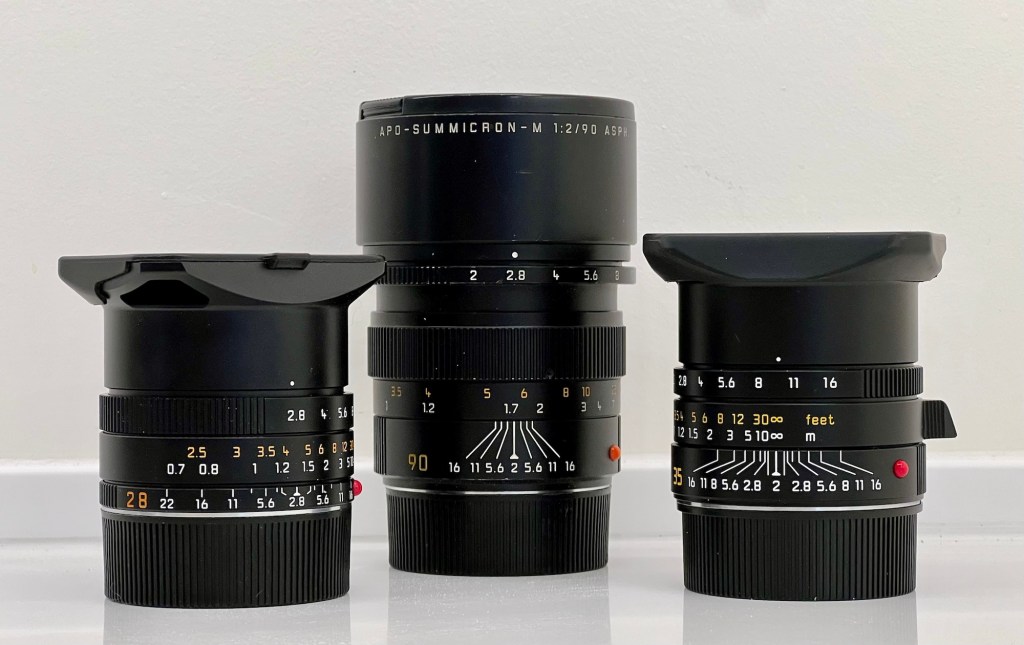
Now that I found the camera body that I want, I need to add some lenses. As with the camera there were a few things I envisioned a need for.
Prime lenses, no zooms. Leica’s sweet spot is prime lenses and generally in the range of 24mm-135mm. The cameras viewfinder has a fixed magnification so no matter what lens you have on the camera the view through the viewfinder remains the same. To account for this Leica identifies the lens you have attached and shows frame lines, in the viewfinder, for you to use to compose your image. This gets more complicated with the different viewfinder magnification levels available on the camera. The Leica M6 has three magnification levels, 0.58, 0.72 and 0.85. My camera has 0.72 magnification which has frame lines for 28mm, 35mm, 50mm, 75mm, 90mm and 135mm. So, these are my focal length choices.
There also is the speed of the lenses to take into consideration. Super-fast lenses, fast lenses and slow lenses. By that I mean how much light gets through the lens to expose the film. The faster the lens the larger they are and the heavier they are. But if one plans to take a lot of images in dark situations there is a real benefit in getting a fast lens. If you regularly use a tripod, then the additional weight and size is not such a big factor whereas if you plan to handhold most of the time size and weight become an important factor. A fast lens lets you use a faster shutter speed which isn’t important when shooting on a tripod but can be very important when shooting handheld. I plan to use this camera handheld, so lens speed is very important, but so is weight and size.
I expect to be using the camera in relatively close proximity to my subject so wide-angle lenses are preferred but having a little reach expands my options. If I want more reach I can use my Sony digital setup with my long focal length lenses, it’s also setup to be used on a tripod. The lenses that will give me that reach is the 90mm and 135mm.
Now that I know the range of focal length available to me there comes the task of selection. At first, I was overwhelmed with the terms Leica uses for their lenses, SUMMILUX, SUMMICRON, ELMARIT, SUMMARIT, and others. There are also subsets of these lenses like SUMMICRON-M and SUMMICRON-R, the M6 body uses the SUMMICRON-M version. My interest in purchasing used lenses further complicates the selection since many of the Leica lenses have changed their makeup over the 50 or so years the lenses have been available. But then the true meaning of those names I mentioned became clear.
They all relate to the speed, f/stop, of the lens. All SUMMILUX lenses have an f/stop of f/1.4, SUMMICRON lenses have an f/stop of f/2.0 and ELMARIT lenses have an f/stop of f/2.8. This is where I stopped and narrowed my search to these 3 classifications of lenses.
Now to decide on the focal length of the lenses that will become residents of my camera bag. To help with that decision I turned to Lightroom. My standard ‘walk-around’ lens had been the 24mm-105mm lens. I’ve had these lenses for all my favorite cameras, 2 models of Canon 5D and two models of Sony A7. Within Lightroom I can filter all images by camera and lens. So, for those cameras with the 24mm-105mm lens Lightrooms filter resulted in 37,487 images. Since these are zoom lenses, the focal lengths were all over the place, so I counted the images for each of the available Leica lens plus/minus 3 lengths. So, for example, for the 35mm I counted the number of images between 32mm-38mm, etc. My far the most used focal length is 24mm which is more than double any other range. This is followed by the 35mm, 50mm and 28mm on the short end. Not so many on the long end although there are many images taken at the long, 105mm, end.
My target is to have 3 lenses to cover my desired range. Ideally, I would get the 24mm but the sight lines in my M6 only work with the 28mm, on the low end. Getting a 24mm required either totally guessing on the composition or getting a compatible viewfinder capable of including the full view of the lens. So, I opted for the 28mm since I wanted the widest lens I could get without additional equipment. (I will probably revisit the need for the 24mm after I’ve had time with the 28mm.) For the longest lens I chose the 90mm, the 135mm is longer than I want to carry, at least at the present. So, it came down to the choice between the 35mm and 50mm. I’ve never been a real fan of 50mm lenses, the framing just looks too tight, so I opted for the 35mm. Yea, it’s just a step up from the 28mm and narrows the view just a little but not so tight as the 50mm. Time and experience will tell how much I miss that gap between the 35mm and 90mm. Do I really need the 50mm instead?
I now have the 3 focal lengths and need to decide on the lens speed. SUMMILUX lenses are very attractive given their f/1.4 aperture but as mentioned earlier they are much larger and heavier than the slower lenses. As tempting as they are, I’m going to go with their siblings. In the end I went with the ELMARIT, f/2.8, for the 28mm and SUMMICRON, f/2.0, for both the 35mm and 90mm.
While I’m happy with the selections I still have some doubt about my choice. Fortunately, the used market for Leica lenses is very robust.
Now that I have the Camera body and lenses next is the film. (This will be a much shorter section, I promise).


 Back to Film
Leave a reply to Larry Gates Cancel reply